If you have spent the last 10, 15 or 20 years building a mortgage broking business, you have almost certainly asked yourself the same question at some point: what happens to everything I have built when I am ready to stop?
It is one of the most important questions a mortgage broker can ask — and one of the least well answered. Unlike financial advisers, who have access to a well-developed market for buying and selling client banks, mortgage brokers in the UK have historically had very few clear exit options. Many end up simply closing the door and walking away, often without receiving anything close to fair value for the client relationships they spent decades building.
This guide is written specifically for directly authorised mortgage brokers in England and Wales who are thinking about retirement — whether that is in one year or ten. We will cover the three realistic exit routes available to you, the pros and cons of each, and what you should be thinking about now to protect your income and your clients when the time comes.
Why mortgage broker exit planning matters more than ever
The UK mortgage broking industry has reached a significant crossroads. A generation of brokers who founded or joined firms in the late 1990s and early 2000s are now in their 50s and 60s. Many of them built their businesses from scratch, weathered the 2008 financial crisis, navigated the Mortgage Market Review, and came out the other side with loyal client banks and established reputations.
The challenge is that mortgage broking businesses are notoriously difficult to value and sell. Unlike a wealth management firm, where assets under management provide a clear and measurable metric, a mortgage broker’s revenue is largely transactional. This makes it hard to put a number on what a mortgage broking business is worth — and it means that many brokers, when they finally decide to retire, discover that the exit they imagined is far harder to achieve than they expected.
The three realistic exit strategies for directly authorised mortgage brokers
Option 1 — Sell through your network or to a fellow broker
If you belong to a mortgage network, the most natural exit route is to approach the network itself or fellow brokers within the community about acquiring your client bank. Some networks facilitate this process informally, and in some cases a trusted colleague may be willing to take on your book and pay you a negotiated sum.
This approach can work well when you have strong existing relationships within the network and a willing buyer who genuinely understands what your client base is worth. The significant challenge, however, is valuation. There is no established market price for a mortgage broker client bank, no standard multiple, and no objective benchmark to guide either party.
This route is also simply unavailable to directly authorised firms with no network affiliation. If you hold your own FCA permissions and do not belong to a network, finding a buyer through this channel is extremely difficult.
Option 2 — Do nothing and wind the business down
Many mortgage brokers, faced with the complexity and uncertainty of finding a buyer, take what appears to be the easiest route: they stop taking new business, service their remaining clients for as long as they can, and eventually let their FCA permissions lapse.
This is understandable — but for most brokers who have built a meaningful client bank over many years, winding down without a plan means leaving a very significant amount of value on the table. There is also a regulatory dimension: the FCA expects firms to treat clients fairly even at the point of exit.
Option 3 — Income share with a trusted directly authorised firm
The third option — and the one we believe is right for most directly authorised brokers with a quality client bank — is to transfer your mortgage and property finance clients to an established, trusted DA firm and receive a share of the income they generate throughout your retirement.
Rather than trying to agree on a single lump sum valuation of your business, you and the acquiring firm simply agree on a percentage of income that will be paid to you on each case that completes after the transfer. Your clients are looked after properly. The acquiring firm is financially motivated to retain and service them well. And you receive a regular, ongoing income that reflects the actual performance of the book you built.
What to look for in an income share partner
Not all income share arrangements are equal. If you are considering this route, there are several things you should look for in a potential partner firm.
- They should be directly authorised. This means they understand your regulatory environment and can manage a clean, compliant transfer between two DA businesses.
- They should be active, practising brokers. A firm still writing mortgage business every day understands what your clients need and why the relationships you have built are worth protecting.
- They should be transparent about how the income share is calculated. The split, the reporting structure, and the term should all be agreed upfront in writing before anything moves.
- They should be honest about whether your book is a good fit. A trustworthy partner will tell you honestly if they do not think the arrangement will work.
When should you start planning your exit?
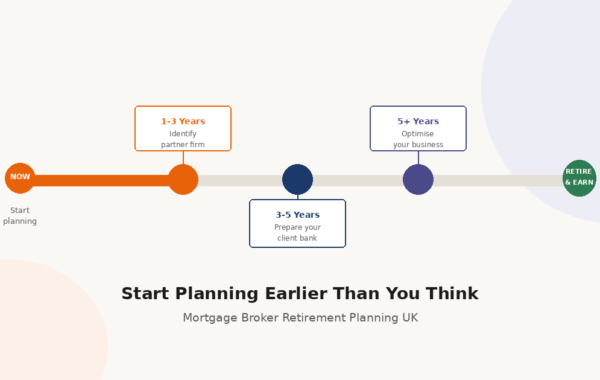
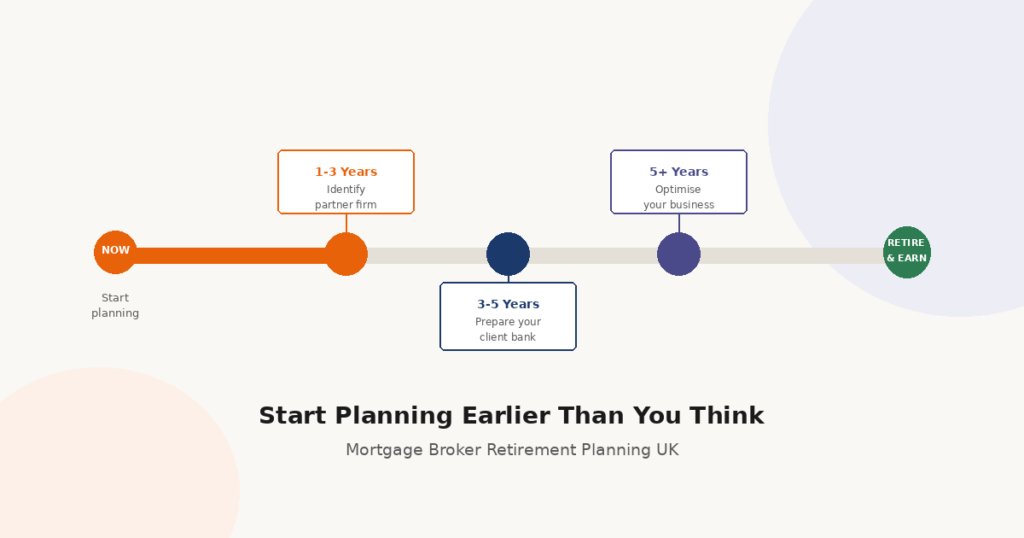
The answer, without exception, is earlier than you think. The brokers who achieve the best outcomes from succession arrangements are those who begin planning while their business is still active and growing — not those who wait until they are exhausted and ready to stop immediately.
If retirement is five or ten years away, an initial conversation with a potential successor costs you nothing and commits you to nothing. If retirement is closer — within the next one or two years — the time to act is now.
Next steps
At Broker Exit, we are directly authorised mortgage brokers ourselves. We founded Niche Advice Limited in Surrey in 2008 and have been running it ever since. We understand your world because we live in it every day. If you are a directly authorised mortgage broker in England and Wales thinking about your exit, get in touch for a completely confidential, no-obligation conversation.